What a Data Service Provider does
VM0047 sets a tree planting project’s baseline by comparison with real places, not by projecting the past forward. That takes analysis: somebody has to build the stocking index, find the comparison areas, run the matching and produce the numbers the project is validated and verified against. A Data Service Provider is the party that supplies that analysis.
For a developer, the practical point is who stands behind the analysis. If the developer produces it, auditors and buyers will ask whether it was steered. Independent analysis with a method anyone can rerun removes the question. Verra’s methodology documents are on its VM0047 page.
Verra publishes the providers it has vetted, announced in May 2026 and September 2026. Vetting confirms that a provider’s approach to stocking index data meets the methodology’s performance benchmark requirements. It does not guarantee that a project’s data will be accepted, since every project is still reviewed by Verra and by the validation and verification body, and a project may use a provider that is not on the list. The list narrows the search. It does not make the choice.
Three kinds of provider
The providers on the list are not one kind of company, and it helps to know which kind you are talking to. Broadly there are three, and each has an honest strength.
Global map producers. The stocking index comes from a worldwide biomass or forest structure product the provider already makes, and the VM0047 service is built on top of it. The strength is coverage and speed: the map exists before you ask. The thing to press on is how the global product behaves in your landscape, and what the matching does beyond drawing on it.
Firms for whom baseline data is one line of a wider business. Ratings, supply chain monitoring, climate risk or commodity data. The strength is resources and reach. The thing to press on is where the baseline work sits in the business, who does it, and how the firm handles the fact that it may also assess, rate or trade what it measures.
Project-specific matching services. The comparison areas and the index are built for each project rather than read off a global product. The strength is fit to the place. The thing to press on is whether the process is a method or a person: can it be rerun, and is the record complete? This is the kind of provider we are.
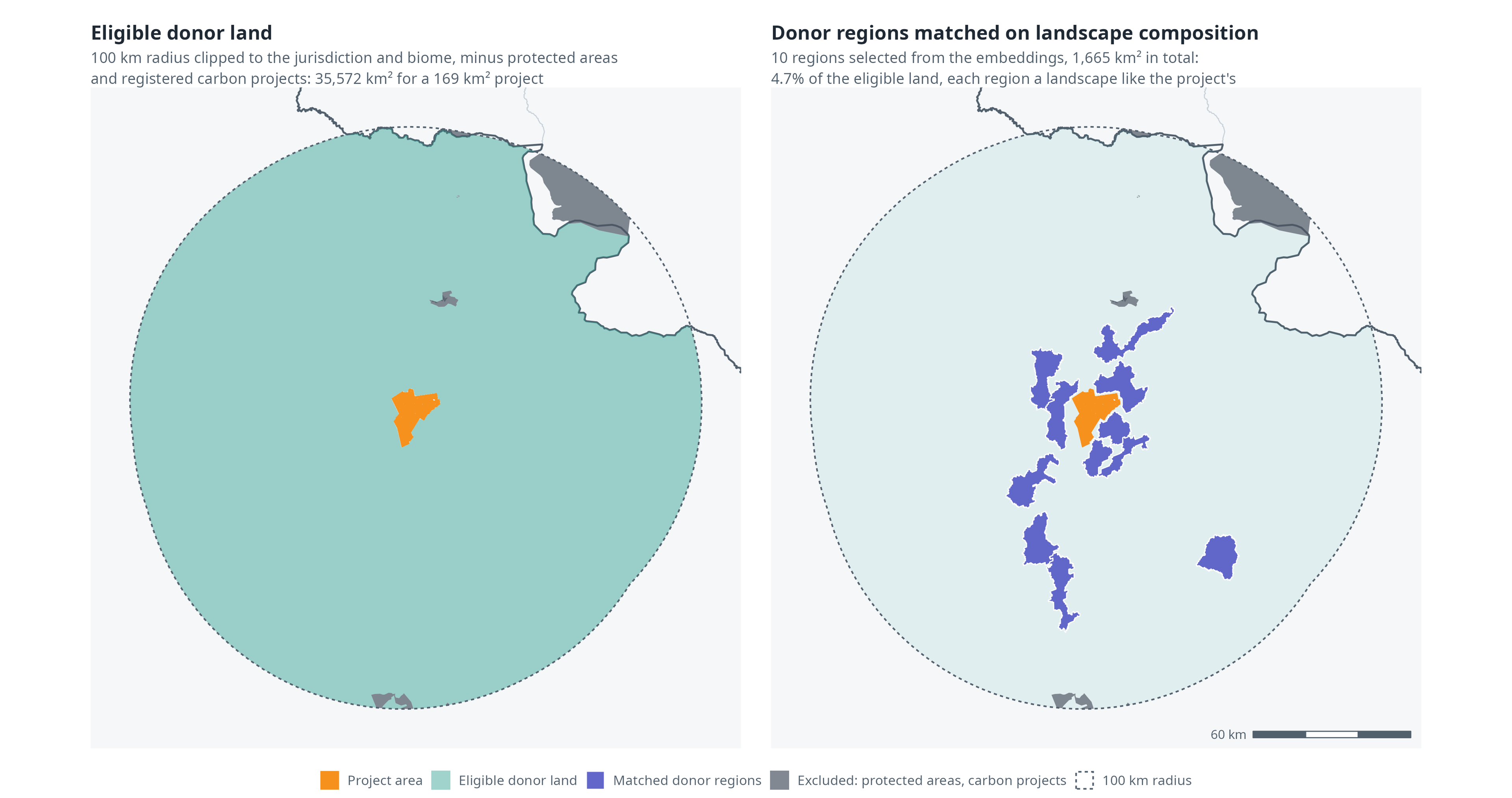
Left, the land the methodology allows. Right, the areas a matching process selected inside it. A registered VM0047 project, analysed from public information for this example. The project’s developer did not use our method; the figure shows what it would have produced.
Ten things to consider when choosing a Data Service Provider
Reference area selection is the decision a project carries longest, and it is better to question it before validation than after. These apply to any provider, us included, and to work done in-house. Each says what to ask for, so that the answer is something you can look at rather than something you are told.
- 01
Everything downstream is measured in it. VM0047 asks for an index that tracks biomass, produced every year from the same season, at 30 metres or finer.
What to ask for: The definition of the index, the evidence that it tracks biomass in forest like yours (field plots, lidar, or both), the resolution, and the years it covers.
- 02
Every stocking index rests on satellite products, and every product has a licence. Public data is fine, and often better, provided the provider can say exactly what it did with it.
What to ask for: The sources named, with their versions, and the licence terms for commercial use of the outputs.
- 03
The matching can only choose from the areas the search considered. The quality of everything after this step depends on it.
What to ask for: A map of the eligible area and of the pool the matching actually drew from, with each rule that took land out (jurisdiction, ecoregion, land tenure, protected areas, other carbon projects, distance) and where the rule came from.
- 04
A control plot has to stand in for the project for decades. Similar in what, measured how, and how close is close enough?
What to ask for: The variables the match was made on, the balance between project and control plots on each of them against the threshold the methodology sets, and a map of the selected areas beside the project.
- 05
A selection has to be defended twenty years into a crediting period, so it cannot depend on who ran it or on choices nobody wrote down.
What to ask for: The written method, and a rerun with the same inputs. The same reference areas should come back.
- 06
Whoever chose the variables the comparison runs on shaped the result. The fewer hand-made choices there are, the less there is to explain to an auditor.
What to ask for: A list of every choice made by hand, the reason for each, and who made it.
- 07
Exclusions settled before the analysis runs cannot be tuned to the answer. Exclusions revised after seeing the result are a choice made on the outcome, and an auditor will read them that way. Settling them first is also cheaper, because it avoids reruns.
What to ask for: The eligible area and any exclusions agreed in writing before the run, on grounds the methodology recognises such as land tenure, and confirmation that the matched plots are fixed for the crediting period, as VM0047 requires.
- 08
Every step should exist as a record someone can follow: what was compared, what was chosen, the reasoning, and the arithmetic from the plots to the performance benchmark. A record reconstructed after the fact is not a record.
What to ask for: The pack the validation and verification body will work from: the plots with their series, the balance statistics, the benchmark calculation with its statistics, and the formats they arrive in.
- 09
Validation and verification generate questions, and the answers have to hold up in front of people who do this for a living.
What to ask for: Named people, their history of answering findings under Verra, a commitment to respond in writing until each finding is closed, and clarity about which findings are theirs and which are the project’s.
- 10
Most years of a crediting period are not verification years. A developer still wants to know how the project is doing in those years, and should not pay audit prices to find out.
What to ask for: A price per project stated before the work starts, with reference areas included however many the analysis needs, and a lower price for a year that produces the number but not the audit materials.
Our own answers, and our prices, are on our VM0047 page. The argument for why the selection decision matters this much is in our essay on VM0047’s defining decision.
Part of our VM0047 page, which explains how a VM0047 baseline is built and what belian.earth supplies.
Related reading
Where the belian.earth team has written on the questions this page raises.
VM0047's brave call is your ARR project's defining moment
by belian.earth
VM0047 locks the developer's matched reference areas at validation and keeps them fixed for the full crediting period. That single choice defines your ARR project's baseline for decades.
Read articleResearchWhy Forest Restoration Projects Need Robust Counterfactual Baselines
by Christopher D. Philipson
Every forest carbon project depends on a counterfactual baseline to demonstrate its impact. Whether avoiding deforestation or restoring degraded land, the underlying question is the same: what would have happened without the intervention?
Read articleOpinionThe carbon baseline problem nobody wants to talk about
by belian.earth
The carbon market has an integrity problem. But while the industry obsesses over which biomass map to trust, the real uncertainty is in the carbon baseline.
Read articleStay in the loop
Stay up to date with developments in independent reference area selection and carbon market baselining.