

Absurdity has always existed in carbon markets, to some extent. But we’re reaching levels of it that begin to push incredulity.
At a time when companies are likely to face growing pressure to buy credits from the UN’s new carbon market (PACM) rather than the Voluntary Carbon Market (VCM), the new proposed Afforestation/Reforestation (A/R) methodology adds insult to injury. It would lock in historic baselines for 15 years, while leading voluntary methods can update theirs dynamically against closely matched land and only credit the extra growth. The methodology appears to compensate for this with a series of arbitrary discounts that trade accuracy for (unreliable) conservativeness.
A compliance market that is lagging behind the integrity of the voluntary market, while also undermining accuracy, is absurd. We should be doing accurate accounting and reasonable discounting as opposed to less accurate accounting and overzealous discounting.
What improvements the Voluntary Carbon Market has made
The VCM now incorporates, under Verra’s VM0047, Isometric’s Reforestation Protocol and Equitable Earth’s restoration methodology, dynamic baselines for Afforestation, Reforestation, and Revegetation (ARR). This ensures that such activities are actually additional compared to similar land, as well as only crediting stock increases that go beyond what is occurring in similar areas. Additionally, these dynamic baselines are continually re-assessed, ensuring that changes in comparable lands are taken into account over time, and crediting for these activities is only based on the ex-post actual results compared to the same ex-post time period in other areas.
The proposed new baseline and monitoring methodology for Afforestation and Reforestation currently open for public comment under the PACM, A6.4-PMM012, does none of this.
An excuse not to look, a baseline built on assumptions
The PMM012 baseline approach chosen uses actual or historical emissions, adjusted downward. Here, “actual” means the carbon on the site at the start, which is assumed to stay the same for 15 years without the project. Historical data are used to check that the land is eligible. The downward adjustment is a set of default margins for uncertainty and change, which reduce the credits. PMM012 justifies this approach due to “Limited Sectoral Data Availability,” “High Site-Specific and Activity-Dependent Variability” and “Heterogeneous Sector Characteristics.” But the provided justifications are no reason to keep the baseline static. Under the UN rules for this same approach, PMM012 could, and should, use a baseline that changes over time and is measured against a control group of similar land. As drafted, it does not, and projects using it would have no option to. The existence of methodologies and corresponding projects in the VCM is direct evidence that dynamic comparison is possible.
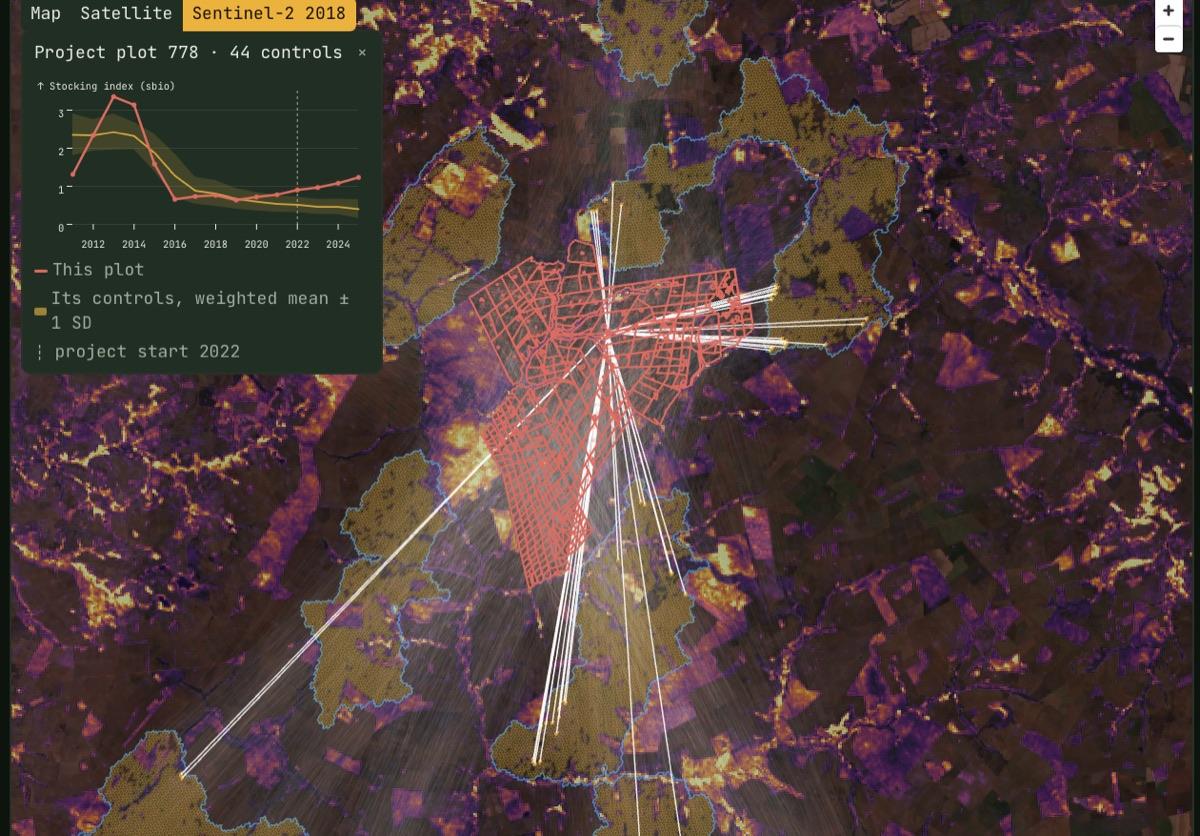
VM0047’s area-based approach answers all three justifications. Where data from comparable projects are limited, it monitors comparison land by satellite, using a stocking index (a measure of how much forest is standing). Where sites vary, it matches project plots to control plots with similar histories, within the same jurisdiction, ecoregion and type of land tenure, and tests the match. And rather than applying a sector average, it gives each project its own benchmark, updated at each verification.
It is possible to go further. Two areas can look identical on a stocking index while sitting in completely different landscapes: a back garden surrounded by houses can match a forest patch on greenness alone. At belian.earth, we build a fingerprint of the project area from satellite embeddings, compressed descriptions of a place’s satellite record. We then search the eligible landscape for areas that match it, and apply VM0047’s matching approach inside those areas. Rather than a reason not to do the matching at all, the justifications given in PMM012 are really reasons to match more carefully.
Crediting A/R projects against a fixed baseline risks overcrediting, which is the primary reason for the changes made to VCM methodologies. There are two major reasons why:
-
In plantation forestry, a project should not be credited for the entire stock increase from zero, but compared with what would have happened on similar land without it, whether that is natural regrowth, planting or no change; and,
-
When left alone, many sites targeted for restoration, agroforestry, etc, would have had some amount of natural regrowth.
Neither can be known at the start. PMM012 instead offers two counterfactuals, both at the extremes: the land stays exactly as it is, or it is planted like neighbouring projects of the same type. It then credits against whichever is more conservative. What actually happens on comparable land is usually a mix of planting, regrowth and no change, and only a dynamic comparison with that land captures it. Without one, PMM012 will over-credit some projects and under-credit others.
Arbitrary adjustments may or may not be conservative
The A/R draft methodology awkwardly addresses this through a range of arbitrary adjustments that may or may not be conservative:
-
Section 10.3 para 60 states “To safeguard against such over-crediting, evidence is provided that no trend of biomass increase has been observed in the past 10 years, and none is expected in the foreseeable future based on current land use.” In reality, many places will see some biomass increase on degraded or abandoned lands, even if they won’t naturally reach a forest threshold. While the latter is an explicit applicability condition (para 8(ii)), dis-allowing land with any natural regrowth will prohibit many projects.
-
To guard against still undercounting potential growth, it then layers on further adjustments:
-
A “downward adjustment” is applied that adds 1% of the pre-project baseline stock each year, reaching 15% by the end of the first 15-year crediting period, when the baseline is reset (Eq. 1, paras 60 and 62). But it entirely depends on local factors whether this is conservative or not. In the tropics, for example, natural regeneration may exceed this substantially. And because it scales with the stock already on the land, on degraded sites with little woody biomass, 1% of almost nothing is almost nothing.
-
There is also an arbitrary 10% “uncertainty adjustment factor” on the same pre-project stock (×1.10, para 61), borrowed from the 10% sampling precision threshold in the CDM tool AR-TOOL14. Again, this may or may not be conservative. The A6.4 baseline standard does require a downward adjustment for historical baselines, but it sets the initial one as the lower of the 95% lower-bound uncertainty or 10% of the gap between baseline and activity emissions (para 67(a)), not 10% of the baseline stock. A benchmark approach, like the dynamic baselines now used in the VCM, would take no initial adjustment at all (para 66).
-
Identifying a baseline scenario only requires looking at the exact type of A/R activity within a 30km radius; natural regrowth is excluded by definition (para 50). Section 10.4, paragraph 65 argues that this 30km is, compared to Verra’s VM0047, “a more stringent locality constraint, further reducing the risk of basing the BAU on dissimilar conditions.” There is no evidence that this is an accurate statement. A radius is not a measure of counterfactual quality. There is no matching or balance test applied to actually demonstrate this. The comparison is a category error. VM0047's 100 km is the outer limit (with some exception where needed) of a donor pool from which controls are selected by covariate matching and then tested for balance. PMM012 takes every AR activity from the past three years inside 30 km. Counterfactual quality comes from how comparable the reference sites are, not how close. Nor does PMM012 say how much planting nearby makes the planted scenario "plausible" (para 64): one plantation within 30 km, or half the landscape. That judgement is left to the developer and validator.
-
Paragraph 66 (Section 10.4.1) misreads what uncertainty is for. Its own Equation 2 adjusts the business-as-usual estimate by the full uncertainty, which is sound. A table borrowed from the CDM's AR-TOOL14 then cuts this back: no adjustment at 10% uncertainty or less, then 25%, 50% and 75% of it up to 30%. In PMM012's worked example, 60 ± 9 m³/ha becomes 62.25 m³/ha rather than the 69 its own interval implies. The steps have no stated ecological or statistical basis, and they create cliffs: the deduction doubles between 15.0% and 15.1% uncertainty, which invites gaming. The confidence level behind the interval is also never defined. An uncertainty interval already sets the bounds on the true value, so its limit should be the discount, and that discount scales linearly with the uncertainty. The only policy choice is the confidence level, which should be stated and justified. It doesn't have to be 90%, if the bound is too harsh, lower the level; don't invent tiers.
-
PMM012 bans synthetic nitrogen fertiliser and then counts no fertiliser emissions at all, while still allowing manure and compost. VM0047 allows both types and deducts their emissions.
Missing market leakage
Leakage gets similar treatment. The methodology accounts for activity shifting using the CDM's AR-TOOL15, but sets market leakage to zero, calling it immaterial and not attributable with reasonable certainty, and cites the approach taken by VCM standards as support (para 72). That support isn't there. VM0047’s area-based approach requires market leakage to be quantified with VMD0054, and states it “must not be assumed to be de minimis.” VMD0054 estimates the production a project displaces, assumes most of it is replaced elsewhere and some of that on newly cleared forest, and lets projects reduce leakage by proving productivity gains on nearby land. PMM012 hands the arithmetic to an old CDM tool and offers no way to earn leakage down. For a methodology that leans on conservativeness everywhere else, dropping a whole category of leakage is a curious place to be generous, without analysis to justify it.
Safeguards leave gaps and advances
Article 6.4 handles safeguards through separate, mandatory rules that apply to every activity, whatever methodology it uses. The A6.4 Sustainable Development Tool requires an environmental and social risk assessment and management plan, and its criteria include avoiding involuntary resettlement, obtaining free, prior and informed consent where an activity affects Indigenous Peoples’ territory, land or resources, equitable benefit sharing with Indigenous Peoples, protecting biodiversity and not introducing alien species. Every activity also goes through local and global stakeholder consultation before registration, and affected communities can turn to the mechanism’s independent appeal and grievance procedure.
PMM012 adds some ecological design criteria of its own, requiring at least three species with none above half the stems, species suited to future climate, no synthetic nitrogen fertiliser, and a fair share of benefits for landholders, in line with local lease rates. The SD Tool frames consent around Indigenous Peoples and ties recognition of their rights to host Party law, where VCS v5.0 also extends consent and jointly designed benefit sharing to customary rights holders more broadly. A revised SD Tool with criteria for forest-based removals is still in draft.
Permanence: a door with no exit
PMM012 applies the Article 6.4 rules, including a buffer contribution sized by a reversal risk tool that is still in draft, and monitoring for 100 years after the last crediting period. With up to 45 years of crediting, that is a liability of up to 145 years. The ways out are to cancel every credit ever issued, to buy insurance the Supervisory Body approves (which hasn’t happened yet), or to demonstrate “negligible risk”, which requires the stored carbon to have reached a steady state and be expected to stay there for at least 100 years. As we argued in Who’s Afraid of the Big, Bad Forest?, the exit condition cannot be met by a biological system. The authors seem to know it; paragraph 98 concedes that the evidence behind the 100-year horizon is thin and geographically skewed, and that the horizon itself is a policy convention.
Compare this with Verra’s requirements, a 40-year project longevity requirement, a pooled buffer that holds significant credits, remote sensing to watch for losses after crediting ends, and a pilot that lets projects use insurance or a fund in place of the buffer. None of this means temporary storage is worthless. Carbon held in trees for 40 or 50 years delays warming, and that mitigation has already happened when credits are used. A rule that turns every A/R activity into a century-long liability with no realistic exit doesn’t make forest carbon more permanent. It just keeps it out of the mechanism.
While we agree that permanence is critical and must be well-managed, this leaves no reasonable options for many landholders and communities, where locking in an agreement for 145 years may be either impossible or meaningless. We encourage further consideration of fund- or trust-based mechanisms for long-term permanence management.
Why default to assumptions?
Overall, this methodology delivers significant backsliding compared to methodological advances in the VCM. It appears to mitigate this somewhat through a range of arbitrary adjustments (that may or may not succeed in delivering conservative results). This begs the question, why would we default to assumptions, rather than promote accuracy? The turmoil in carbon markets over the last 5+ years has resulted from critique of technical accounting measures. It is absurd to think compliance markets should take us backward, when more accurate, dynamic approaches not only exist, but have already been proven workable (from a technical standpoint, at least).
This is combined with unworkable permanence rules, that will leave many landholders and communities out of the mechanism, while not ensuring the most high quality reductions from those that do move forward. We urge this methodology to be significantly improved, and to incorporate a dynamic baseline approach in line with current best practices.
Supporting annex: Comparison tables for A6.4-PMM012, Verra's VM0047 and Isometric Reforestation (PDF, 10 pages), setting the three side by side on baselines, leakage, permanence and safeguards.
Questions and answers
›What is PMM012?
A6.4-PMM012 is the proposed Article 6.4 baseline and monitoring methodology for afforestation and reforestation of lands except wetlands, open for public comment under the Paris Agreement Crediting Mechanism (PACM). It uses a static baseline: the carbon on the site at the start is assumed to stay the same for 15 years without the project, adjusted downward by a set of default margins.
›How does PMM012 differ from VM0047 and other voluntary ARR methodologies?
Verra's VM0047, Isometric's Reforestation Protocol and Equitable Earth's restoration methodology use dynamic baselines: the project is compared with matched control land and re-assessed at each verification, so only growth beyond what happened on similar land is credited. PMM012 fixes its baseline for 15 years and offers no option to compare against a control group, although the Article 6.4 baseline standard allows one.
›What is wrong with PMM012's 30 km locality constraint?
PMM012 claims a 30 km radius is a more stringent locality constraint than VM0047's 100 km. A radius is not a measure of counterfactual quality. VM0047's 100 km is the outer limit of a donor pool from which control plots are selected by covariate matching and then tested for balance. PMM012 takes every A/R activity from the past three years inside 30 km and applies no matching or balance test.
›What are the permanence requirements under PMM012?
PMM012 applies the Article 6.4 rules: a buffer contribution sized by a reversal risk tool that is still in draft, and monitoring for 100 years after the last crediting period. With up to 45 years of crediting, that is a liability of up to 145 years. The exits are to cancel every credit issued, buy insurance the Supervisory Body approves, or demonstrate negligible risk, which requires the stored carbon to have reached a steady state expected to last at least 100 years.
Stay in the loop
Stay up to date with developments in independent reference area selection and carbon market baselining.
Policy context
The frameworks behind this piece, explained in plain English.
Related posts
belian.earth vetted by Verra as a VM0047 Data Service Provider
by belian.earth
Verra has vetted belian.earth as a Data Service Provider for VM0047, the methodology for tree planting projects. What that means for a developer, what we do differently, and what a view costs.

Who's Afraid of the Big, Bad Forest?
by Chloé Naomi Swickard
Permanence has been a sticking point for Nature-Based Solutions since the Kyoto debates. The ICVCM Permanence Trust may finally unlock long-term durability. Even then, the deeper question of how nature gets financed will remain.
VM0047's brave call is your ARR project's defining moment
by belian.earth
VM0047 locks the developer's matched reference areas at validation and keeps them fixed for the full crediting period. That single choice defines your ARR project's baseline for decades.