

Why we named the company after belian
belian.earth is named after the belian tree. In English it is the Bornean ironwood, Eusideroxylon zwageri, and it lives for more than a thousand years. With its high wood density it stores a large amount of carbon, and it is so resistant to rot and termites that the timber is highly sought after.
Nature-based carbon is criticised for not lasting. This tree does. For us, the name stands for permanent carbon storage and our long-term view.
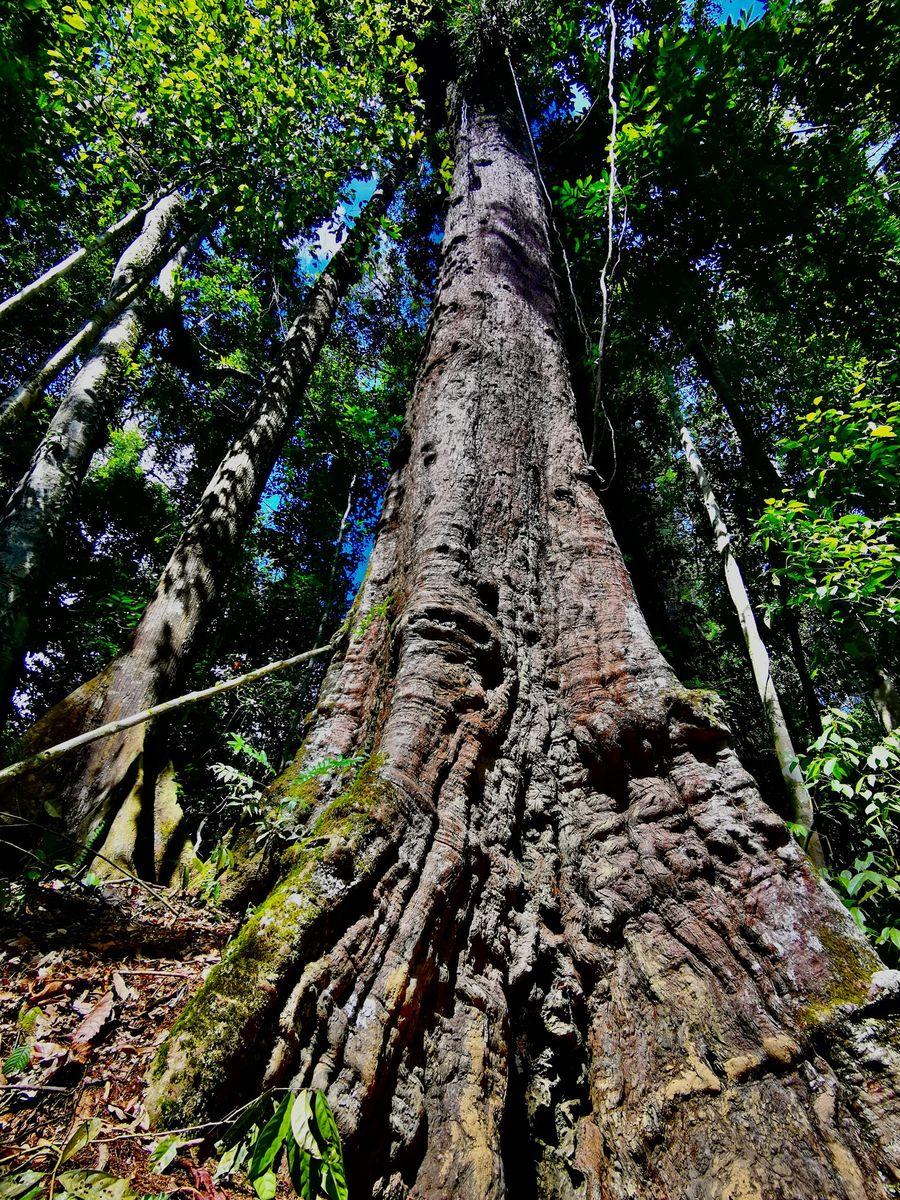
A mature belian in Bornean rainforest, carrying the pitted, pocked bark the species is known for. Photo: Unding Jami, SEARRP.
It also links us to our roots. I spent years working in the forests of Sabah, learning from the people there, and belian is the tree everyone gets excited about. There was such heavy logging of belian trees across Borneo that they are not so common in logged forest. I have fond memories of the whole field team crowding round when we found a belian in the field plots. So we named the company after belian. We're here for the trees, after all.
What the word belian means
The Bahasa Melayu (Malaysian language) name for the belian tree is belian, and the word is used across Sabah, Sarawak and Brunei. Kayu belian refers to the timber, and the standing tree is pokok belian. Cross into Indonesian Borneo and the same species is ulin, or kayu ulin for the wood, which is the name most of the Indonesian research uses. In the timber trade both words point at this one species.
Read the rest: the tree's other names, its Latin name, two unrelated Malay words and a Dayak healing ceremonyShow less
The tree itself carries a lot of names. In Indonesia: ulin, belian, tebelian, tulian and onglen. In Sabah you will also hear tambulian. The Berawan of Sarawak call it terras. In the Philippines it is tambulian or sakian. In English it is Bornean ironwood or Borneo ironwood, and in older timber records billian; the French trade calls it bois de fer. In Jambi in Sumatra people tell several ironwood varieties apart by eye, and a 2015 study set those local names beside the trees' form and their DNA (Irawan et al. 2015). Sarawak gazetted belian as its official state tree on 20 March 1984 (Sarawak Gazette No. 1484). In Iban, a language of Sarawak, belian is a diamond, the stone and the suit of cards. I used to think that was because a diamond is pure carbon and very hard, like belian wood. In actual fact, that is a loanword from the Dutch briljant.
The scientific name is Eusideroxylon zwageri. Eusideroxylon is built from the Greek for iron and wood, with "true" on the front. The species is named after Zwager, a Dutch official, and the tree was described by Teijsmann and Binnendijk in 1863 (Kew, Plants of the World Online).
Two other Malay words are spelled belian and have nothing to do with the tree. One is beli with the ending -an, meaning a purchase, which is useful when you're shopping for field supplies. The other is an old word for a shaman, still sometimes used in Borneo, which goes back to an Austronesian root reconstructed as *balian, "shaman, shamaness, shamanistic ceremony" (Blust and Trussel, Austronesian Comparative Dictionary). Same spelling, different words: none of the three is related to the others.
That third sense is not dead in Borneo. Among Dayak communities in East Kalimantan, the Benuaq and the Luangan among them, a belian is a healing ceremony: an overnight performance led by a shaman to call back the spirit of someone who is ill. Herwig Zahorka catalogued the plants used across a four-night belian sentiu ritual (Zahorka 2007), and Isabell Herrmans has written a book on the practice (Herrmans 2015). So in Borneo the word belian can point at a tree or at a ceremony, depending on who you ask and where you are standing. The same root surfaces right across the region: a healer is a balian in Bali, a babaylan in the Philippines and a bobohizan among the Kadazan-Dusun of Sabah (Blust and Trussel, Austronesian Comparative Dictionary).
What belian is: a thousand-year tree in the Lauraceae family
If you look at the forest canopy in Borneo, it is dominated by dipterocarps, with dipterocarps accounting for up to 80% of the canopy in many of these forests (Whitmore 1984). The family is a very diverse one, so while the canopy is many different species, it mostly comes from a single family.
The belian sits apart from all that. It is in the Lauraceae family, the laurels, with bay, cinnamon and avocado for relatives, and it is the only species in its genus. It grows to about 50 metres, with a trunk that can pass a metre across (IUCN 2025). I first saw it at Sepilok Forest Reserve, near Sandakan, twenty-five years ago, where it is one of the few common trees that is not a dipterocarp.
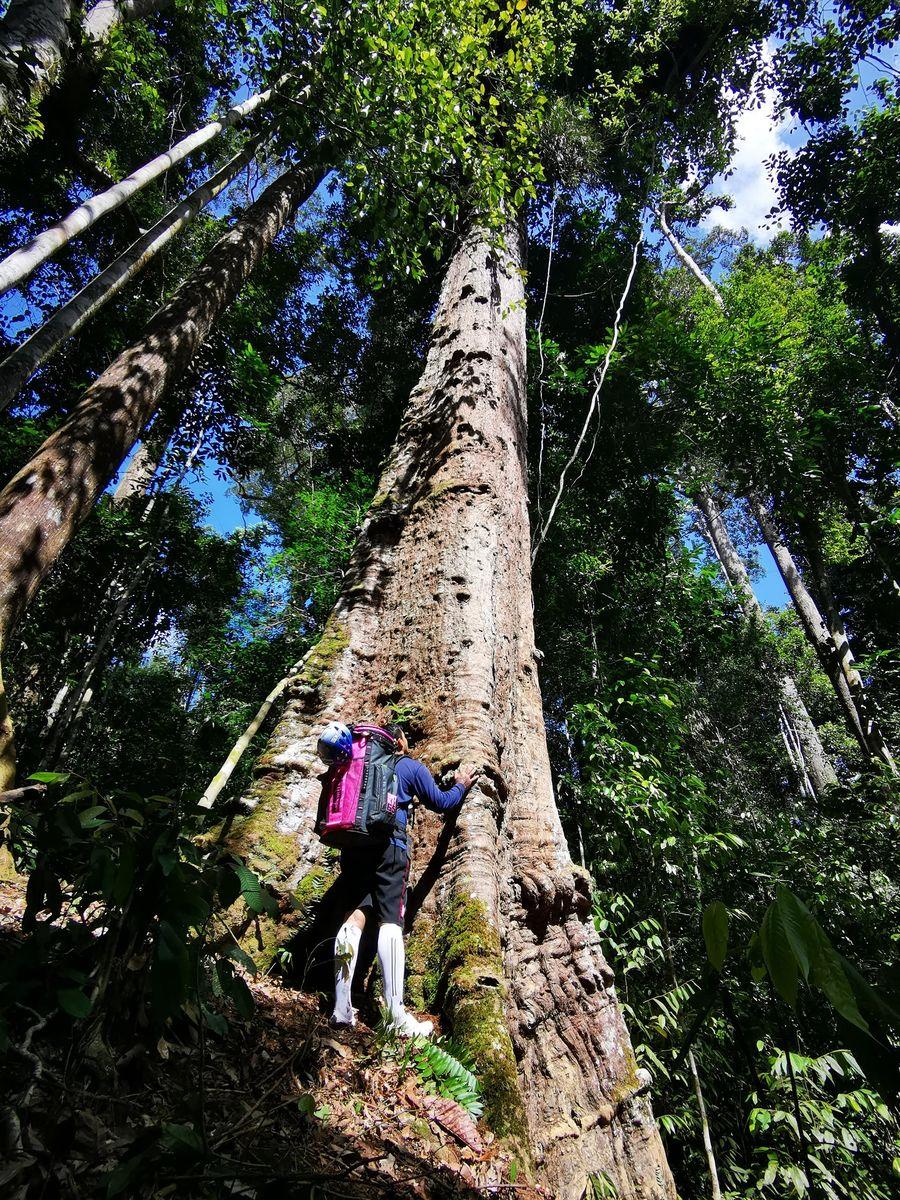
Unding Jami of SEARRP with a belian in Danum Valley, Sabah, on the walk out from the field station to Menara. Menara is a dipterocarp, a yellow meranti, and at 100.8 metres the tallest tree in the tropics. For a few years everyone was competing over measuring the biggest one, and Unding is the climber who settled it with a tape in 2019 (Shenkin et al. 2019). This one is a belian.
We know belian lives more than a thousand years because someone carbon-dated it. In 2003 Hiroko Kurokawa and colleagues radiocarbon-dated wood from fifteen logged belian stumps in Kubah National Park, a small park behind Kuching in Sarawak (Kurokawa et al. 2003). The innermost sound wood of a 121-centimetre stump came out at 838 years old, and the tree had a rotten heart beyond that, so the whole tree was older still. Across the stumps the wood had thickened by roughly a millimetre of diameter a year. A belian you can just get your arms around has been there for several centuries.
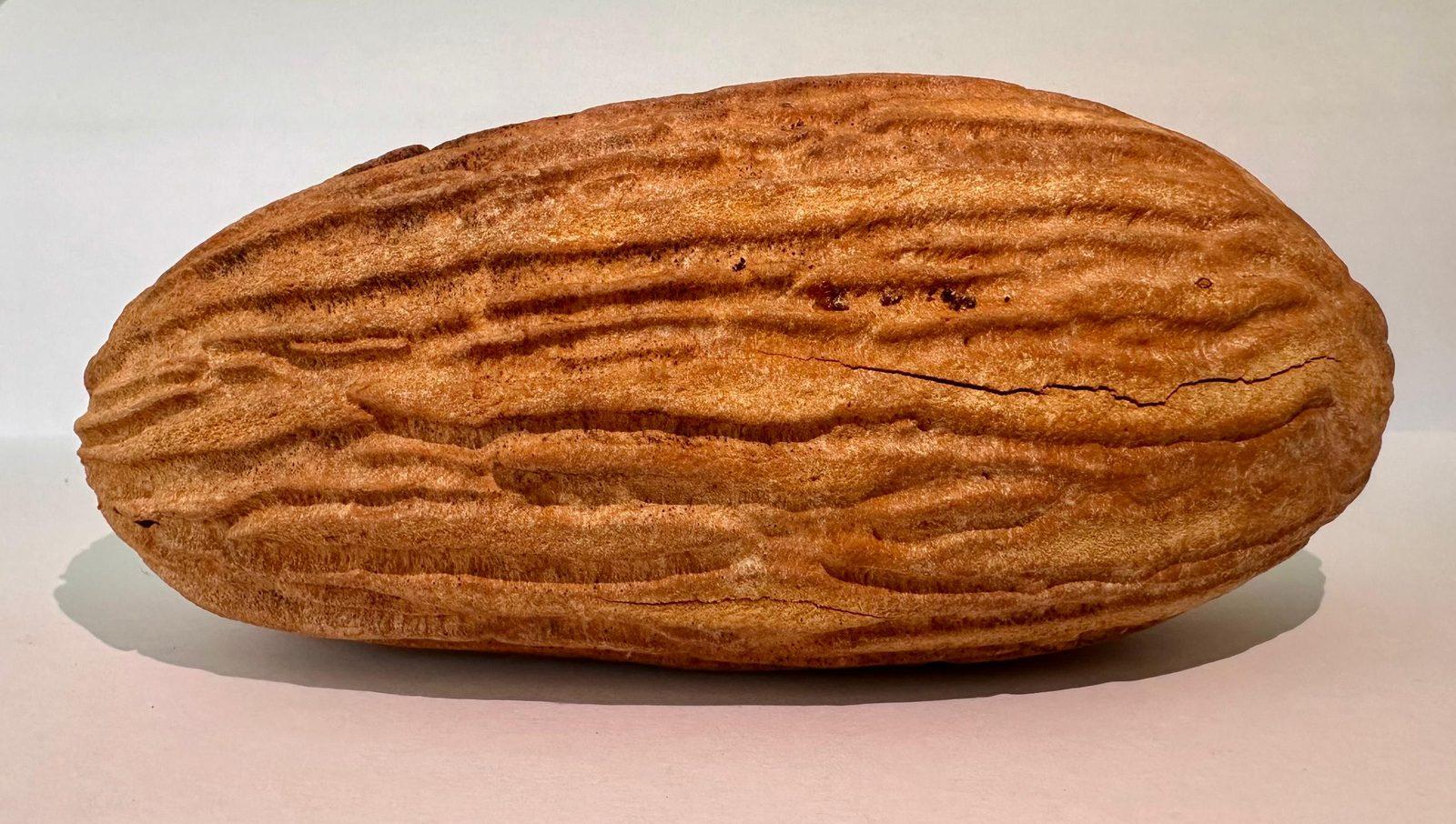
A belian seed. They are seven to fifteen centimetres long. Photo: Unding Jami, SEARRP.
Read the rest: how slowly it grows, why the wood is so dense, seeds and seedlings, and how to recognise oneShow less
The same paper compared the ages of belian and dipterocarps. The estimated lifespans of dipterocarps at full size ranged from 60 to 570 years. The growth rate of belian was among the very slowest of them, and its lifespan was well beyond any. Kurokawa's group suggested the tree may keep fruiting for 800 years or more, and put the long life down to the density of the wood and the defensive chemistry inside it. Part of that chemistry has adopted the tree's name: eusiderin, a compound isolated from belian heartwood in 1960 (Hobbs and King 1960). It is a life history strategy: grow slowly, build wood that nothing can eat, and outlast everything around you.
Growth that slow has a consequence for anyone hoping to replace what was cut. Seedlings in the shade of a closed forest hardly ever die, but they hardly grow either. Opening the canopy around a five-year-old seedling roughly trebles its growth (Kiyono and Hastaniah 2000). Even so, a trunk 30 centimetres across is a matter of a century, which is why nobody has ever built a belian plantation at scale. Restoring a logged forest is slow for the same reason, and a synthesis of restoration outcomes across tropical Asia shows what actually works.
Why belian wood is so dense
Dense wood is stored carbon. Two trees of the same size can hold very different amounts of it, and belian is at the heavy end. That is why mapping carbon across Malaysian Borneo means measuring more than canopy height. Measured on planted trees in Sarawak, belian's basic density is about 0.86 grams per cubic centimetre, the same from the centre of the trunk to the bark (Aiso-Sanada et al. 2020); the US Forest Products Laboratory gives 0.86 to 0.92, which works out at about a tonne per cubic metre once the timber is air-dry (USDA Forest Products Laboratory). So belian is a sinker, not a floater. It is also hard enough that a team wanting to core belian trunks in Sabah for growth rings had to design a new drill first (Williams et al. 2015).
In the Global Wood Density Database, the reference set ecologists use to turn tree size into carbon, belian's records sit between 0.71 and 0.84. That puts it in the densest tenth of South-East Asian trees, and denser than the great majority of dipterocarps, whose median is around 0.61. But a few of them, the balau group of Shorea and several Hopea, are just as heavy, and they sink too. What sets belian apart is not that it is the densest wood in the forest. It is that it is very dense, very durable and very old at the same time.
Seeds and seedlings of the belian tree
Each fruit holds a single seed, between seven and fifteen centimetres long, with a ridged coat almost as hard as the timber (Soerianegara and Lemmens 1993). No other tree in Borneo drops a seed like it, so sometimes you find the seed on the ground and then look around for the tree. The IUCN assessment suggests the seeds were once moved by large mammals, some of them no longer in the forest, and that they also travel by water, which is why belian is so often found along river banks (IUCN 2025).
Removing a lot of adult trees has implications for the next generation. In a four-hectare plot of old-growth forest at Maliau Basin in Sabah, Lan Qie and colleagues found fewer young belian than the adults should have produced, clumped rather than spread, and heavily browsed. Seedlings were heavily browsed, with sambar deer the likely culprit, and the losses were density dependent: the more seedlings in a patch, the larger the share eaten (Qie et al. 2019). Qie and her colleagues concluded that keeping the species going will take conservation effort aimed at belian itself, not only at the forest around it.
How to recognise a belian tree
The tree can be recognised by its pitted, pocked, greyish-brown bark. The leaves are simple and elliptic, set in a spiral up the twig rather than in opposite pairs, and a new flush comes out red (Sarawak Forest Department).
Where belian grows
This is a tree of the lowlands. It grows in Borneo (Sabah, Sarawak, Brunei and Kalimantan), in eastern and southern Sumatra and its islands Bangka and Belitung, and in Palawan and the Sulu archipelago in the Philippines (Kew; IUCN 2025). It is a lowland rainforest species, found from near sea level to about 650 metres (Yudaputra, Fijridiyanto and Cropper 2020), on a range of soils, usually scattered through mixed dipterocarp forest at a few trees per hectare, though it can cluster and in places dominates the canopy. While it has been heavily logged, it can persist in old secondary forest.
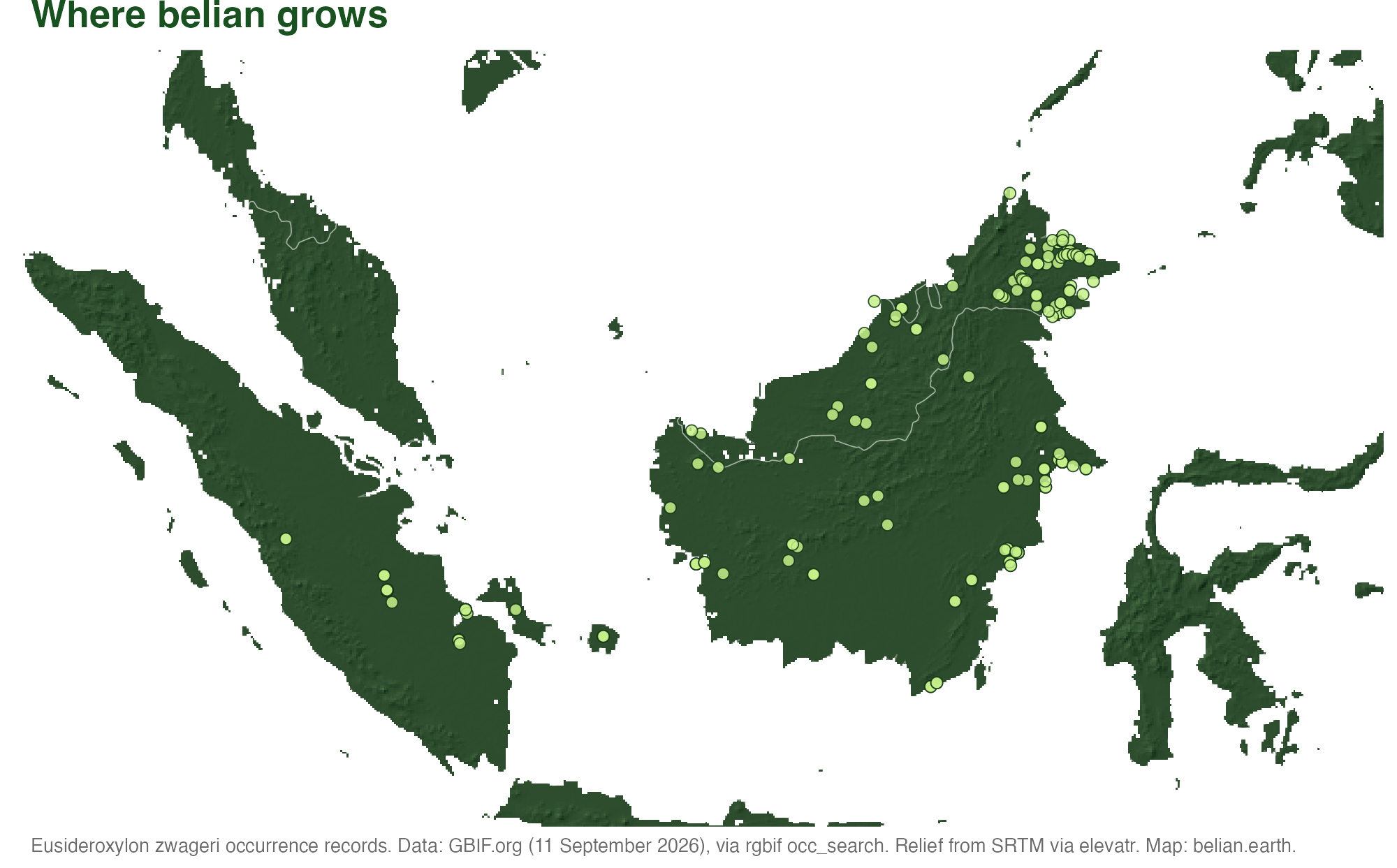
Where belian has been recorded: occurrence records for Eusideroxylon zwageri from GBIF, retrieved 11 September 2026. Hillshade highlights that the records tend to sit in the lowlands, not on the mountains. Cultivated trees outside the native range are excluded, and only records released under CC0 or CC BY are used. GBIF holds only a handful of century-old herbarium specimens from the Philippine part of the range (Tawi-Tawi, 1910 and 1911) and none with coordinates, so Palawan and the Sulu islands are blank here despite belian being native there.
The range is wide. The population inside it is not what it was. Sumatra's belian was described as almost entirely destroyed as long ago as 1994 (WWF and IUCN, Centres of Plant Diversity), and in Borneo the tree is now most reliably found inside protected areas: Danum Valley, Maliau Basin and Imbak Canyon in Sabah, Kubah in Sarawak, and a string of reserves in Kalimantan.
The timber: belian wood and what it is used for
The timber is the reason everyone knows the tree. It is rated in the top durability class: more than fifty years in the open, more than fifteen in contact with the ground, and effectively immune to termites (ITTO). Even the narrow band of sapwood resists decay, which almost no other timber manages; Andrew Wong's group at the Forest Research Institute Malaysia spent years working out why (Wong and Singh 2001). What eventually gets into belian is bacteria, slowly, in wet ground: tunnelling bacteria that bore through the cell walls, first shown under the electron microscope in 1992 (Nilsson, Singh and Daniel 1992).
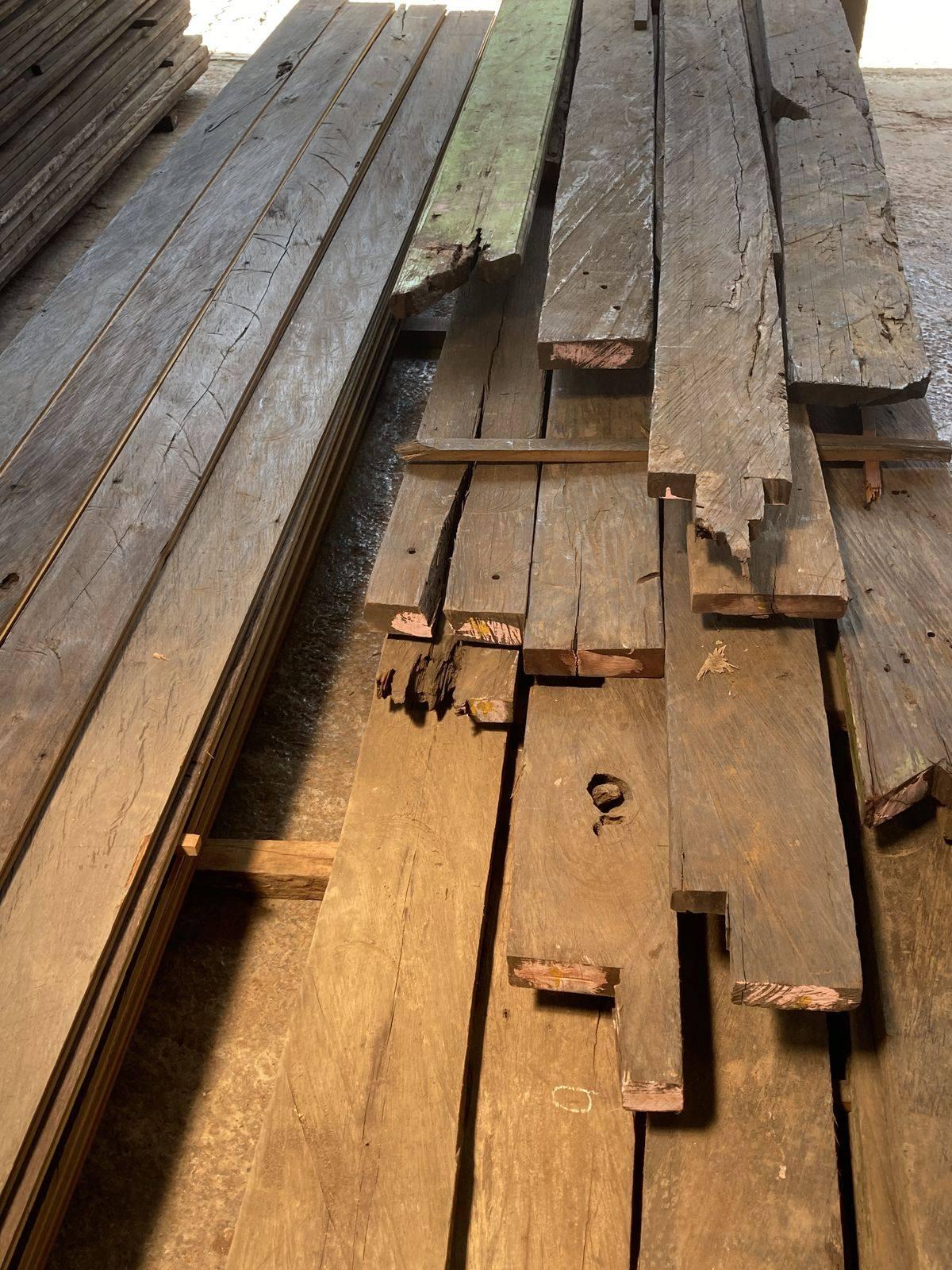
Reclaimed belian. The weathered surfaces have gone grey; the fresh cuts are orange-brown. These boards came out of old structures in Borneo and are still sound.
Read the rest: what belian is used for, what it costs, and how to identify itShow less
So people build with it, and have for as long as there have been longhouses. In Sarawak and Kalimantan the main posts, beams and stilts of a Dayak longhouse are belian, and so are the roof shingles. A belian house post is expected to outlast the house. It goes into jetties, piers, wharves and bridges, and into boats; the Sarawak Forest Department lists longhouse structure, furniture and the posts that pepper vines climb. It has long been valued as coffin wood. In Danum Valley there are belian coffins lodged on ledges of a limestone cliff above the river, carved with animal heads and reputed to be at least 250 years old, still whole in the open air. For the Berawan of Sarawak the tree is a cultural keystone, used in burial rites and carved into posts (Franco et al. 2014).
What belian wood costs, and why
The timber has always been expensive, and the official numbers suggest around ten times the rate for other timbers. Sabah charges an export levy (it calls it a cess) of RM 100 per cubic metre on belian sawn timber against RM 10 for sawn timber of any other species, and the royalty on converted belian, meaning sawn or otherwise processed timber, runs at more than double the general rate (Sabah Forestry Department schedules). Those are state fees rather than market prices, but they are set against what the timber is worth, and belian is the only species the levy singles out by name. The deeper reason is supply: a century to reach thirty centimetres across, no plantation at scale, and legal felling restricted almost everywhere it grows. Most of what you can buy today is reclaimed rather than newly cut.
How to identify belian wood
Four things give a belian board away. Weight is the first, and the most reliable: at around a tonne per cubic metre air-dry it is heavier than nearly anything it could be confused with, and an offcut dropped in water sinks. Colour is the second. A fresh cut is yellowish, sometimes faintly olive, and it darkens on exposure to deep reddish brown and eventually close to black (Commercial Timbers). Old surfaces left outdoors can weather to grey while the wood underneath stays sound, which is the contrast in the photograph at the top of this section. Sapwood is the third: a narrow, distinctly paler band at the edge. Insect damage is the fourth, because of its absence. Termites and borers leave belian alone, so a hundred-year-old beam full of holes is something else. Freshly cut belian is also often described as faintly lemony, which would fit a family that includes camphor, cinnamon and bay.
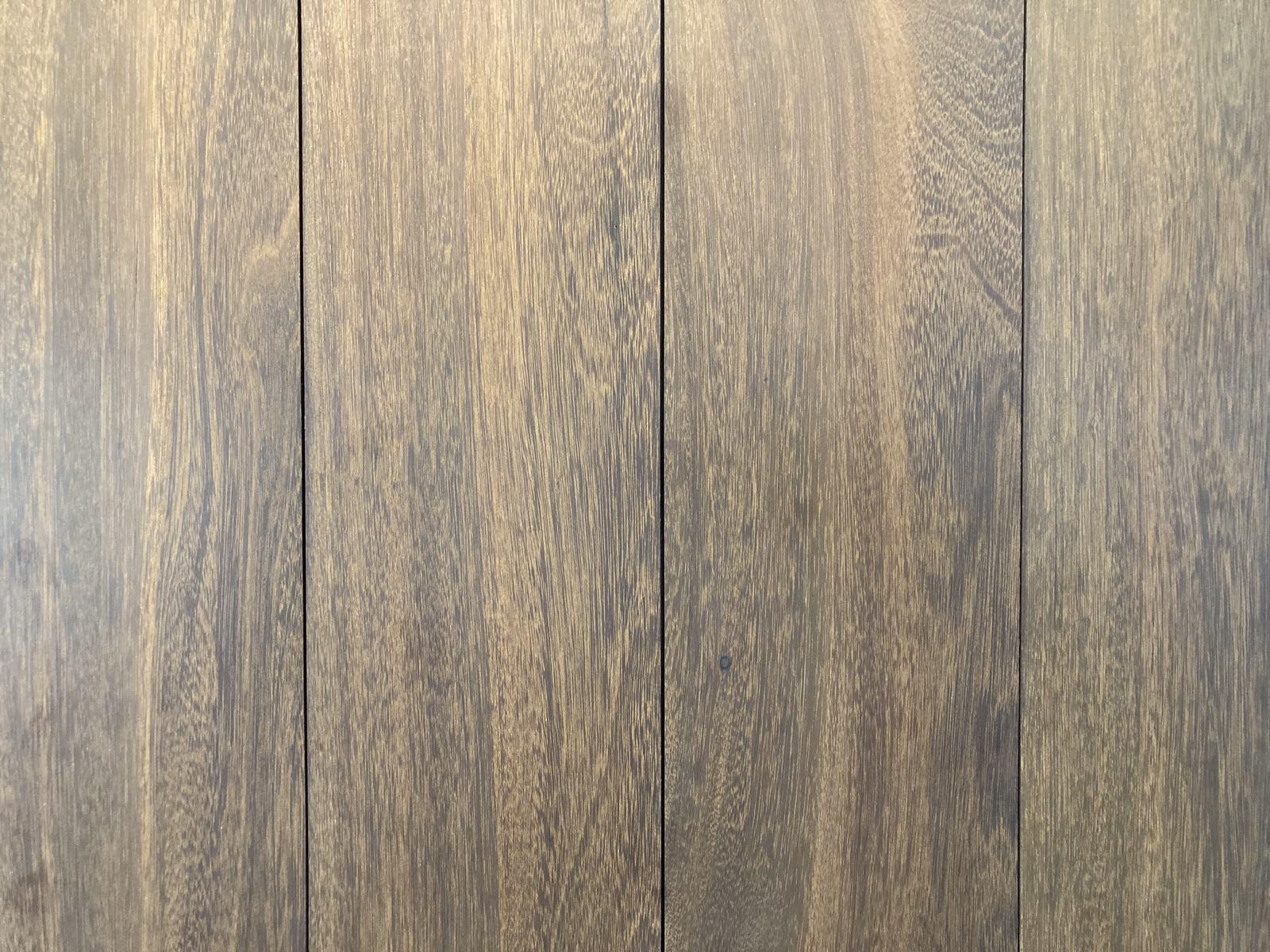
Finished belian wood: fine, even grain running straight along the board, and the olive-brown the heartwood settles at.
Why belian is Vulnerable: logging and conservation
The qualities that make belian a good post made it the first tree to go. Loggers took the most valuable stems first, and belian was the most valuable. The species is listed as Vulnerable on the IUCN Red List, first in 1998 and again in the 2025 reassessment, which suspects a decline of more than 30 per cent over the last three generations, about 300 years for a tree like this, from timber extraction, poor regeneration and the loss of lowland forest to agriculture (Barstow 2025).
People in Borneo have carefully cut belian for houses and boats for centuries, and in West Kalimantan villages had their own rules about who could take it. That use did not endanger the tree. Chainsaws, logging roads and the clearing of forest for timber estates and oil palm did, and the customary rules were never recognised by the state (Peluso 1992).

The belian we named the company after, in logged forest in Sabah. The bole is hollowed and split, which is exactly why it is still standing: loggers took the sound, straight stems and left the defective ones. A lot of the belian you find in a logged forest is there because it was not worth cutting.
The law now varies by border. In Sabah, belian is a prohibited species under the Forest Enactment 1968: it may only be felled in special circumstances such as unavoidable road building or a tree already damaged (Sabah Forestry Department). Sarawak has controlled belian export since the 1950s. Indonesia protected the tree for decades, then recently took it off the protected list, and logging has picked up again (IUCN 2025).
There is a carbon lesson in all this. Often, the trees that logging removes first are the ones that hold the most carbon for the longest. A forest's carbon cannot be measured by area alone, and what was extracted over a century ago still shapes what is standing now. That is the problem our baselines are built to handle, and part of why restoring logged forest matters so much in Borneo. Whether a project protecting forest like this can sell credits at all is decided by the integrity bar the ICVCM sets, and whether a company may count them against its own targets is decided by the SBTi's corporate net-zero standards.
Upcycled belian and Kaltimber
Because belian does not rot, a beam pulled out of a bridge that went up a century ago is still sound timber. That makes upcycling worth far more for this species than for most. A tree takes a hundred years to reach thirty centimetres across and the species is Vulnerable, so reclaimed belian, or kayu ulin as it is called in Indonesia, is the only supply that does not cost a living tree.
The best example I have seen is Kaltimber, who work in nothing but reclaimed ulin and turn it into decking, flooring, furniture and homewares. I have had two tours of their place in Bali and I own some of what they make.
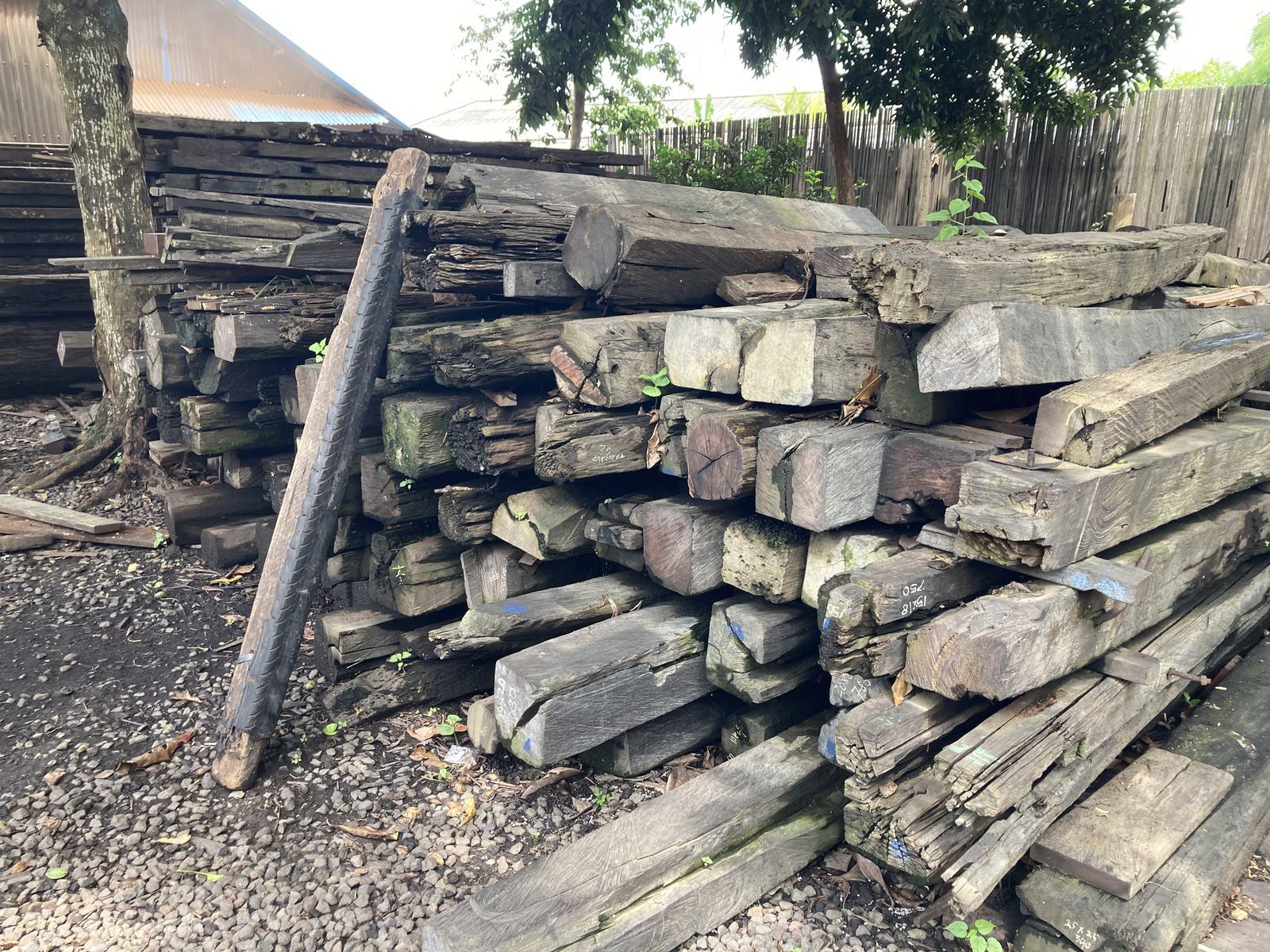
What reclaimed belian looks like before anyone touches it: salvaged beams in the yard at Kaltimber, still carrying the bolt holes from whatever they held up.
Read more on upcycled kayu ulin at Kaltimber in BaliShow less
Kaltimber are at Batuan in Gianyar, a few miles south of Ubud. The Balinese are known for their craftsmanship and for their woodworking in particular.
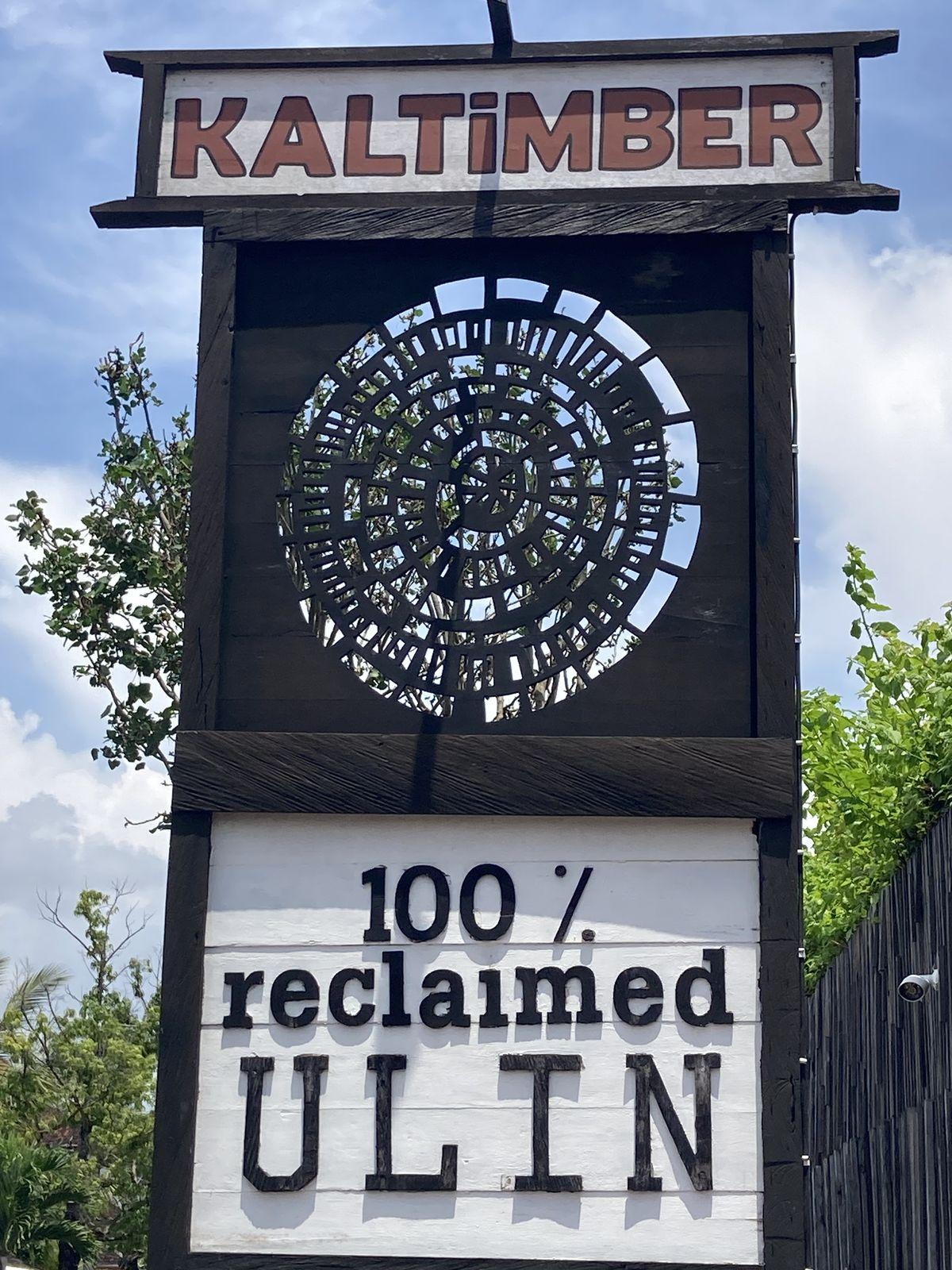
The sign on the road at Batuan, south of Ubud. One species, and none of it newly felled.
What Kaltimber do is bring that tradition together with a modern mill and a commitment to work only with reclaimed ulin. They take old bridges, boats, jetties and warehouses that have been abandoned and cut them carefully into large, sound pieces of timber that can be used again in buildings. Most of it becomes decking and parquet flooring to a very high standard. They also make furniture and woodware, much of which ends up in Bali's hotels, where there is a real push to make tourism more sustainable.
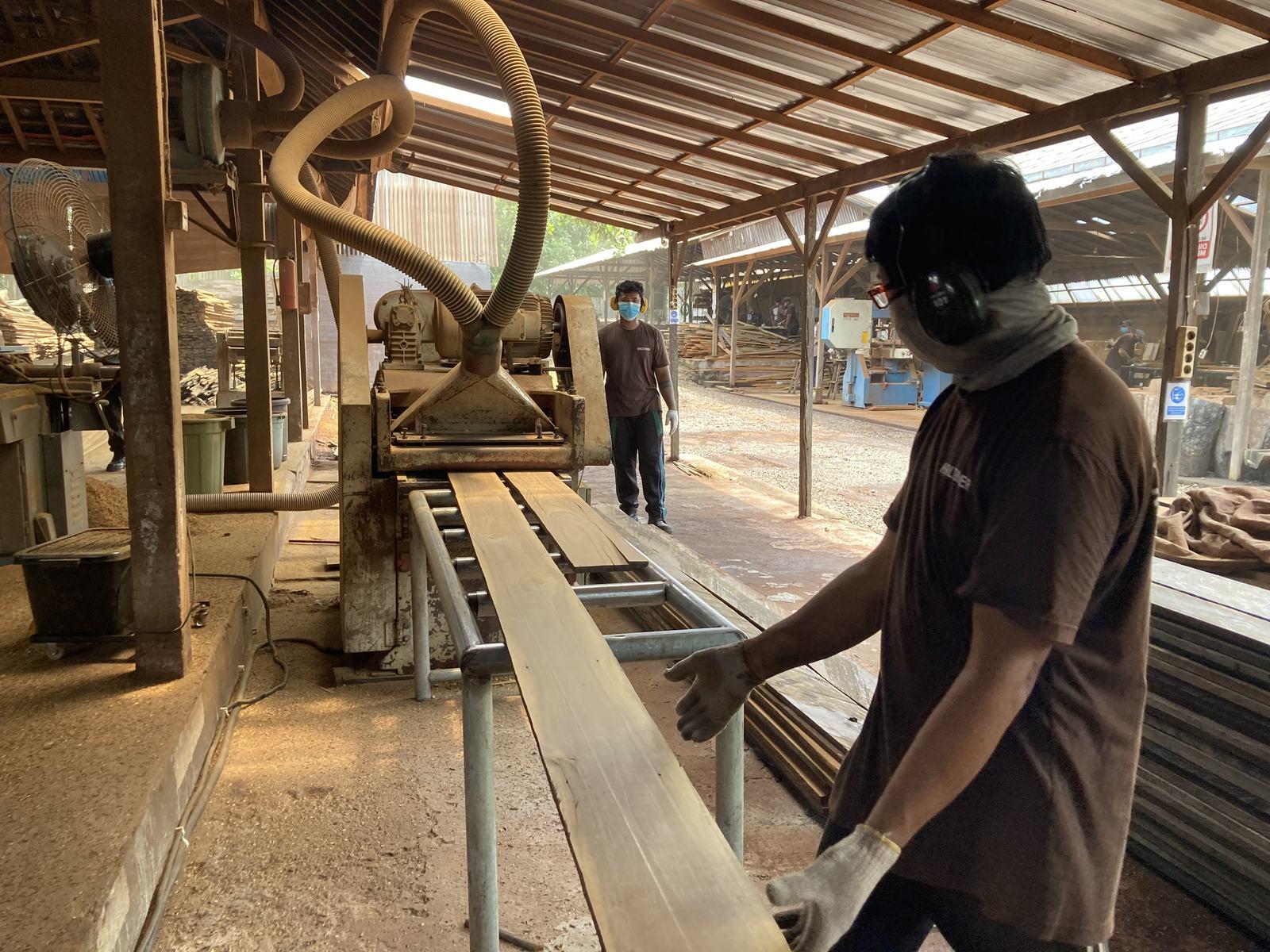
A salvaged board going through the mill. The timber is hard enough that milling it is slow work.
They are good at making sure nothing goes to waste. Boards are sorted and marked by size so that offcuts stay usable, smaller pieces become homewares, and the smallest offcuts of all are turned into beads. I wore a strand of belian beads at the World Economic Forum in Davos, next to a togetherband.
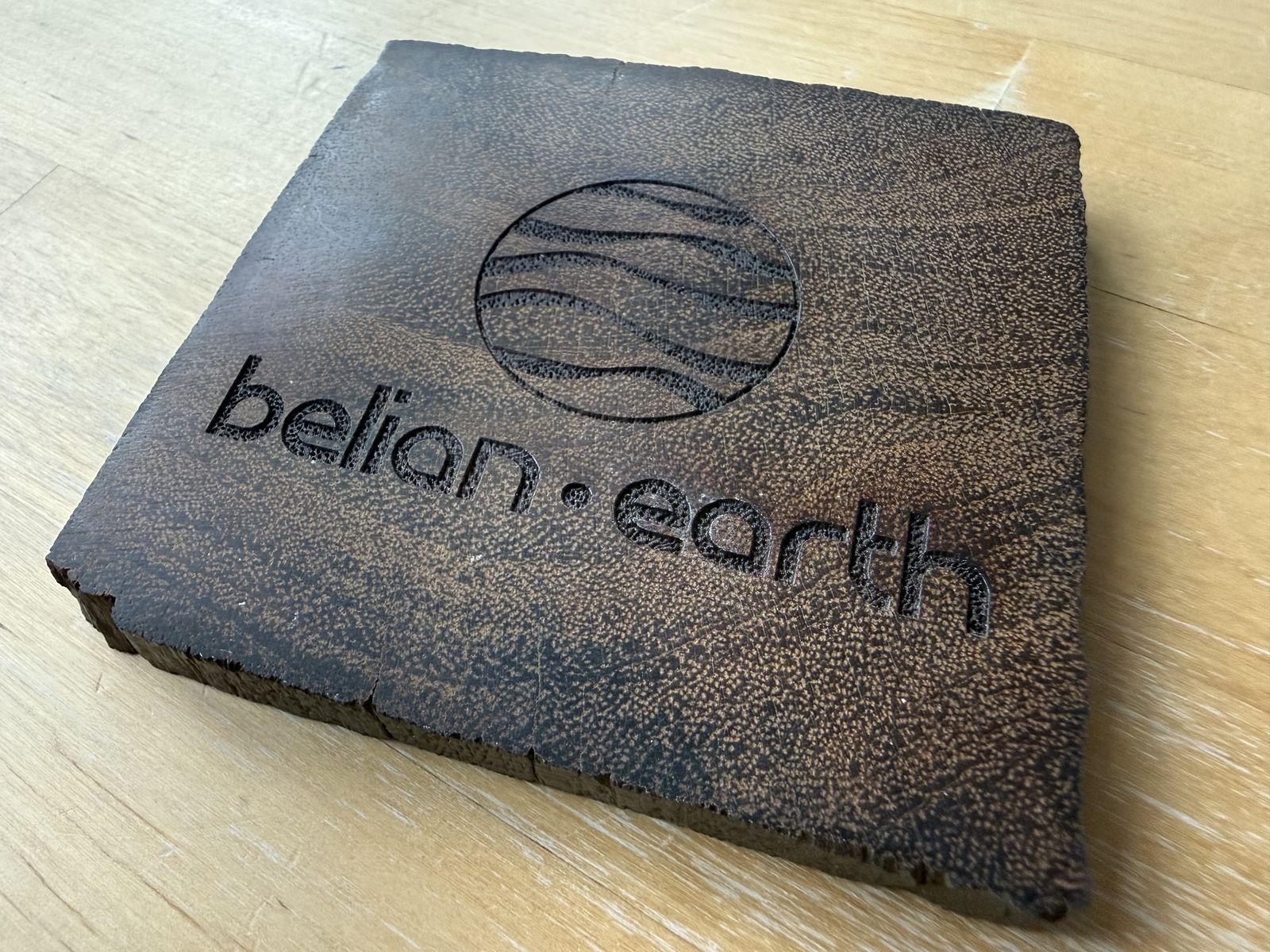
Offcuts become homeware. This one is ours: a coaster cut from reclaimed belian, with the mark burned in. The fine speckling is the wood's own pore pattern.
Everything they work with is reclaimed and they mill no new ulin at all. Their stock is certified under SVLK, Indonesia's timber legality system, and the homewares made from offcuts go out under their own i-Rewood name.
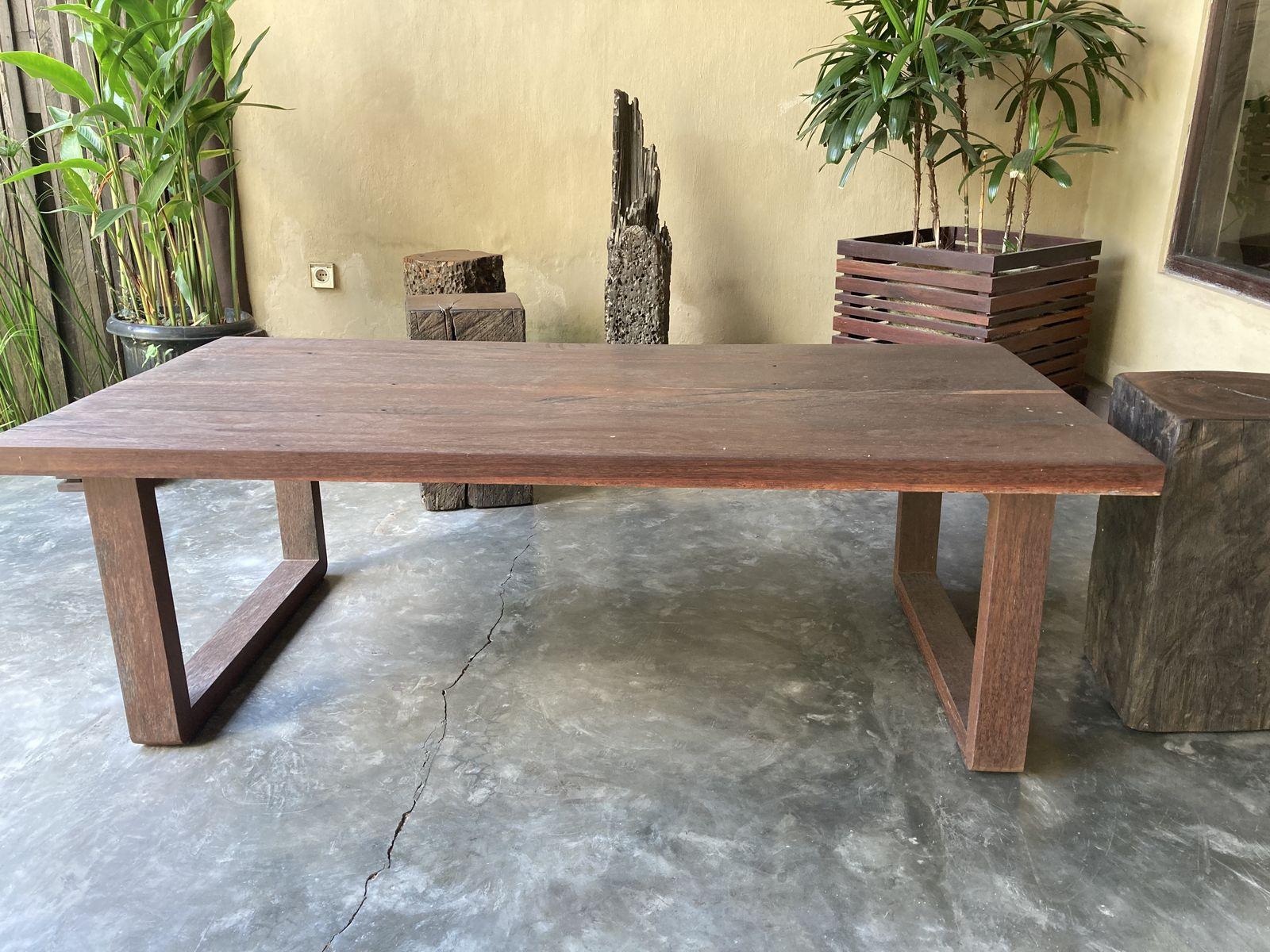
Finished reclaimed ulin. The timber in this table is older than the building it will stand in.
Other things called belian
In Malaysia and Indonesia, belian is an everyday word, so it lands on a lot of different things. On its own it can mean a purchase. As an older word it meant a shaman, and among Dayak communities in East Kalimantan a belian is still a healing ceremony. In Iban it is a diamond. Kampong Sungai Belian is a village in Sarawak, and a number of Malaysian and Indonesian businesses use the name, because in those languages it is simply a word. All of that is set out in what the word belian means.
Outside the region, the mobile game Epic Seven has a character called Belian, which is why searching the bare word returns so many game pages. This page is about the tree, and about belian.earth, the company named after it.
Frequently asked questions
What is belian wood?
The timber of the Bornean ironwood, Eusideroxylon zwageri, a tree of the Lauraceae family from Borneo, Sumatra and the Philippines. It is one of the heaviest and most durable timbers in South-East Asia, rated for more than fifty years in the open and effectively immune to termites.
How hard is belian?
Very. Its basic density is about 0.86 grams per cubic centimetre, around a tonne per cubic metre air-dry, and it sinks in water. It sits in the densest tenth of South-East Asian trees, alongside the heaviest dipterocarps such as balau.
Is belian endangered?
Yes. It is listed as Vulnerable on the IUCN Red List (1998, reassessed 2025), with a suspected decline of more than 30 per cent over three generations from logging, poor regeneration and habitat loss. In Sabah it is a prohibited species and may not be felled commercially.
Where does belian grow?
In lowland rainforest below about 650 metres in Borneo, eastern and southern Sumatra, Bangka, Belitung, Palawan and the Sulu archipelago. Today it is most reliably found inside protected areas.
What does belian mean?
The Bahasa Melayu name for the Bornean ironwood, used in Sabah, Sarawak and Brunei; the timber is kayu belian and the tree is pokok belian. In Indonesia the same tree is ulin. Two unrelated Malay words share the spelling: a purchase, and an old word for a shaman, which survives in Borneo as the name of a Dayak healing ceremony. In Iban, belian is a diamond.
How do you identify belian wood?
By weight first: at around a tonne per cubic metre air-dry, belian is heavier than almost anything it could be confused with, and an offcut dropped in water sinks. A fresh cut is yellowish or faintly olive and darkens on exposure to deep reddish brown or almost black, while a surface left outdoors weathers silver-grey. The sapwood is a narrow, distinctly paler band. Old belian shows no insect damage, because termites and borers leave it alone.
Is belian the same as ulin?
Yes. They are two names for the same tree, Eusideroxylon zwageri. The Malaysian name is belian, used in Sabah, Sarawak and Brunei; the Indonesian name is ulin, used in Kalimantan and Sumatra. Tebelian, tulian, onglen and tambulian are the same species again.
Why is belian wood so expensive?
Because supply is small and very slow to replace. A belian takes about a century to reach 30 centimetres in diameter, it is a prohibited species in Sabah, Sarawak controls its export, and no plantation has ever been established at scale. Sabah charges an export levy of RM 100 per cubic metre on belian sawn timber against RM 10 for any other species. Much of the belian sold today is reclaimed from old piers and buildings rather than newly felled.
How long does a belian tree live?
More than a thousand years. Radiocarbon dating of logged stumps in Kubah National Park, Sarawak, gave ages beyond 1,000 years and a growth rate of about a millimetre of diameter a year.
References
- Aiso-Sanada H, Nezu I, Ishiguri F et al. (2020). Basic wood properties of Borneo ironwood (Eusideroxylon zwageri) planted in Sarawak, Malaysia. Tropics 28(4): 99-103. doi.org/10.3759/tropics.MS19-10
- Barstow M (2025). Eusideroxylon zwageri. The IUCN Red List of Threatened Species 2025: e.T31316A68076738. doi.org/10.2305/IUCN.UK.2025-2.RLTS.T31316A68076738.en
- Chave J, Coomes D, Jansen S, Lewis SL, Swenson NG, Zanne AE (2009). Towards a worldwide wood economics spectrum. Ecology Letters 12: 351-366. Data: Zanne AE et al. (2009), Global wood density database, Dryad, https://doi.org/10.5061/dryad.234 doi.org/10.1111/j.1461-0248.2009.01285.x
- Franco FM, Ghani BAA, Hidayati S (2014). Terras (Eusideroxylon zwageri Teijsm. & Binn.), a cultural keystone species of the Berawan people of Sarawak, Malaysia. Pertanika Journal of Social Sciences and Humanities 22(3): 891-902. www.researchgate.net/publication/271154920
- Kiyono Y, Hastaniah (2000). Growth of Eusideroxylon zwageri seedlings and silvicultural changes in logged-over and burned forests of Bukit Soeharto, East Kalimantan, Indonesia. JARQ 34(1): 63-67. www.jircas.go.jp/en/publication/jarq/34/1/63
- Kurokawa H, Yoshida T, Nakamura T, Lai J, Nakashizuka T (2003). The age of tropical rain-forest canopy species, Borneo ironwood (Eusideroxylon zwageri), determined by 14C dating. Journal of Tropical Ecology 19(1): 1-7. doi.org/10.1017/S0266467403003018
- Peluso NL (1992). The ironwood problem: (mis)management and development of an extractive rainforest product. Conservation Biology 6(2): 210-219. doi.org/10.1046/j.1523-1739.1992.620210.x
- Philipson CD et al. (2020). Active restoration accelerates the carbon recovery of human-modified tropical forests. Science 369: 838-841. doi.org/10.1126/science.aay4490
- Qie L, Elsy AD, Stumvoll A et al. (2019). Impending regeneration failure of the IUCN Vulnerable Borneo ironwood (Eusideroxylon zwageri). Tropical Conservation Science 12. doi.org/10.1177/1940082918823353
- Shenkin A, Chandler CJ, Boyd DS et al. (2019). The world’s tallest tropical tree in three dimensions. Frontiers in Forests and Global Change 2: 32. doi.org/10.3389/ffgc.2019.00032
- Soerianegara I, Lemmens RHMJ (eds) (1993). Plant Resources of South-East Asia 5(1): Timber trees, major commercial timbers. Pudoc, Wageningen. prosea.prota4u.org/
- Wong AHH, Singh AP (2001). The high decay resistance in the sapwood of the naturally durable Malaysian hardwood belian (Eusideroxylon zwageri). International Research Group on Wood Protection, IRG/WP 01-10410. Wong AHH et al. (1995). Soft rot decay of belian (Eusideroxylon zwageri) wood. IRG/WP 95-10119. www.irg-wp.com/irgdocs/
- Sabah Forestry Department. Forest Enactment 1968 and Forest Rules 1969 (Schedule I, Class A: belian); royalty and fee schedule noting belian and merbau as prohibited species (reproduced in Forest Industry in Sabah, 2019). forestpolicy.org/sites/default/files/2019-08/Forest%20Industry%20in%20Sabah_Malaysia_1.pdf
- Nilsson T, Singh A, Daniel G (1992). Ultrastructure of the attack of Eusideroxylon zwageri wood by tunnelling bacteria. Holzforschung 46: 361-368. doi.org/10.1515/hfsg.1992.46.5.361
- Hobbs JJ, King FE (1960). The chemistry of extractives from hardwoods. Part XXIX. Eusiderin, a possible by-product of lignin synthesis in Eusideroxylon zwageri. Journal of the Chemical Society: 4732. doi.org/10.1039/jr9600004732
- Williams RE, Gagen MH, Walsh RPD, Bidin K (2015). On the development of a drill-borer for sampling tropical supra-hardwoods: an example using the Borneo ironwood Eusideroxylon zwageri. Dendrochronologia 35: 99-104. doi.org/10.1016/j.dendro.2015.07.004
- Yudaputra A, Fijridiyanto I, Cropper WP Jr (2020). The potential impact of climate change on the distribution pattern of Eusideroxylon zwageri (Bornean ironwood) in Kalimantan, Indonesia. Biodiversitas 21: 326-333. doi.org/10.13057/biodiv/d210140
- Irawan B, Gruber F, Finkeldey R, Gailing O (2015). Linking indigenous knowledge, plant morphology, and molecular differentiation: the case of ironwood (Eusideroxylon zwageri) in Jambi, Indonesia. Genetic Resources and Crop Evolution 63: 1297-1306. doi.org/10.1007/s10722-015-0317-4
- Zahorka H (2007). The shamanic belian sentiu rituals of the Benuaq Ohookng, with special attention to the ritual use of plants. Borneo Research Bulletin 38: 127-147. borneoresearchcouncil.org/borneo-research-bulletin-indexed-by-volumes-36-40
- Herrmans I (2015). Ritual Retellings: Luangan Healing Performances through Practice. Berghahn Books, New York. www.berghahnbooks.com/title/HerrmansRitual
- Blust R, Trussel S (2010-). Austronesian Comparative Dictionary, web edition: *balian, "shaman, shamaness, shamanistic ceremony". www.trussel2.com/ACD/
- Commercial Timbers: descriptions, illustrations, identification and information retrieval (DELTA/IntKey): Eusideroxylon zwageri Teijsm. & Binnend. (billian, ulin). www.delta-intkey.com/wood/en/www/laueuzwa.htm
- Whitmore TC (1984). Tropical Rain Forests of the Far East, 2nd edition. Clarendon Press, Oxford. archive.org/details/tropicalrainfore0000whit_d3m3
- Sarawak Forest Department (via the 100 Juta Pokok campaign): Belian, pokok rasmi Negeri Sarawak. Gazetted 20 March 1984, Sarawak Gazette No. 1484; bark, leaf and habitat notes. www.100jutapokok.gov.my/news/590
- WWF and IUCN (1994-95). Centres of Plant Diversity: a guide and strategy for their conservation, vol. 2. IUCN Publications Unit, Cambridge. As cited in the APFORGEN priority species information sheet for Eusideroxylon zwageri. static1.squarespace.com/static/54ac9e94e4b0c9d38e248bf6/t/5580f273e4b04f1579607a3e/1434514035093/infosheet_zwageri.pdf
- Daily Express (Sabah): Danum Valley's ironwood warrior coffin attraction. Source for the reputed age of the belian coffins in Danum Valley. www.dailyexpress.com.my/read/4122/danum-valley-s-ironwood-warrior-coffin-attraction/
- Kew Science, Plants of the World Online: Eusideroxylon zwageri Teijsm. & Binn. powo.science.kew.org/taxon/urn:lsid:ipni.org:names:464565-1
- Forest Research Institute Malaysia: Eusideroxylon zwageri, the official tree of Sarawak. www.frim.gov.my/quicklinks/eusideroxylon-zwageri-the-official-tree-of-sarawak/
- International Tropical Timber Organization: Ulin (Eusideroxylon zwageri). www.tropicaltimber.info/specie/ulin-eusideroxylon-zwageri/
- USDA Forest Products Laboratory: Eusideroxylon zwageri, wood technical sheet. www.fpl.fs.usda.gov/documnts/TechSheets/Chudnoff/SEAsian_Oceanic/htmlDocs_SEAsian/Eusideroxylonzwageri.html
More on the science behind our work: our published research and the forest carbon glossary.
Where this connects to the carbon market
belian is a tree. Whether protecting a forest full of them earns a credit, and whether that credit counts for anything, is decided elsewhere.
ICVCM
The ICVCM sets the global threshold standard for quality in the voluntary carbon market. Its Core Carbon Principles and CCP label determine which credits are credible, which methodologies are sound, and where the market needs to go further: REDD+, reforestation, permanence, leakage, and buffer pools.
Read morePolicySBTi
SBTi sets the bar for corporate climate ambition: which emissions companies must cut, when, and by how much, and what role carbon credits, land use, and nature play in a credible net-zero claim. FLAG shapes demand from land-intensive companies; the Corporate Net-Zero Standard shapes the broader credit market.
Read moreResearchWhy Forest Restoration Projects Need Robust Counterfactual Baselines
by Christopher D. Philipson
Every forest carbon project depends on a counterfactual baseline to demonstrate its impact. Whether avoiding deforestation or restoring degraded land, the underlying question is the same: what would have happened without the intervention?
Read article